


Media Profile
Biopharma Beats Bulletin: Spotlight on Tierney Baum, BioCentury
Background
- Name: Tierney Baum
- Email: [email protected]
- Home Base: Research Triangle, NC (fully remote)
- Role: Biopharma Analyst, BioCentury; leads clinical coverage with a focus on therapeutic pipelines, disease landscapes, and translational science
- Expertise: Baum brings a PhD in cell biology, with a background in neurodevelopment and rare disease, to analytical journalism. After an externship during her doctorate convinced her that 10,000-foot thinking suited her better than the lab, she found BioCentury to be a natural fit for her scientific training and writing instincts. “When this position came up, it was like a perfect fit… I feel very lucky actually to have ended up in this role.”
Beat Overview
- Publication: BioCentury is a subscription-based intelligence platform — think analyst firm as much as editorial outlet. Its flagship database, BCIQ, holds 30 years of historical biopharma data on targets, deals, and financing. The readership is senior decision-makers across biopharma and biotech, and nearly everything is behind a paywall. Baum describes BioCentury’s expertise plainly: “We’re not for a general audience.”
- Coverage Areas: Baum runs the weekly clinical report — a roundup of data readouts that drove significant stock moves — and produces deep-dive landscape pieces on disease areas, therapeutic pipelines, and modality trends. Her personal wheelhouse includes neurodevelopment and rare disease, but she covers the full clinical spectrum. “We’re really like deep dive stories on curated topics of interest… diseases, therapeutic pipelines of diseases, what’s coming up next, where are fields headed.”
- Angles of Interest: BioCentury’s north star is differentiation. Baum is consistently looking for under-covered indications gaining momentum, targets that have recently become druggable, and fields where a flurry of activity signals something worth examining. A news event often provides the entry point — but the story is always the landscape, not the headline. Multiple companies circling the same topic in a short window is also a reliable signal: “I recently wrote a story on tuberose sclerosis epilepsy, and that was because I had four new companies reach out to me in the span of a month. I was like, okay, there’s signal here.”
Pitching Tips
- Lead with differentiation, not burden of disease: Baum is explicit that standard framing — unmet need, patient numbers, lack of therapies — is table stakes, not a hook. What she needs to know immediately is how this company or data point adds something new to the field. “How is this company adding to the conversation in this disease? How does that compare to standard of care?” She doesn’t have every indication top of mind, and it’s the PR team’s job to quickly orient her. Concrete shorthand works well: think “first new target in this indication in 25 years” over general superlatives.
- Write for the five-second scan: Baum compares a good pitch to a strong resume — it needs to communicate its value immediately or it loses the reader. Use formatting to your advantage: bold the key claim, surface the most differentiating point in the first sentence or two, and don’t bury the lead in background context. “Assume that the person doesn’t have time to go to the website. Give me all the basics about why this is differentiated — bold, highlight, whatever you have to do to make it really obvious right away.”
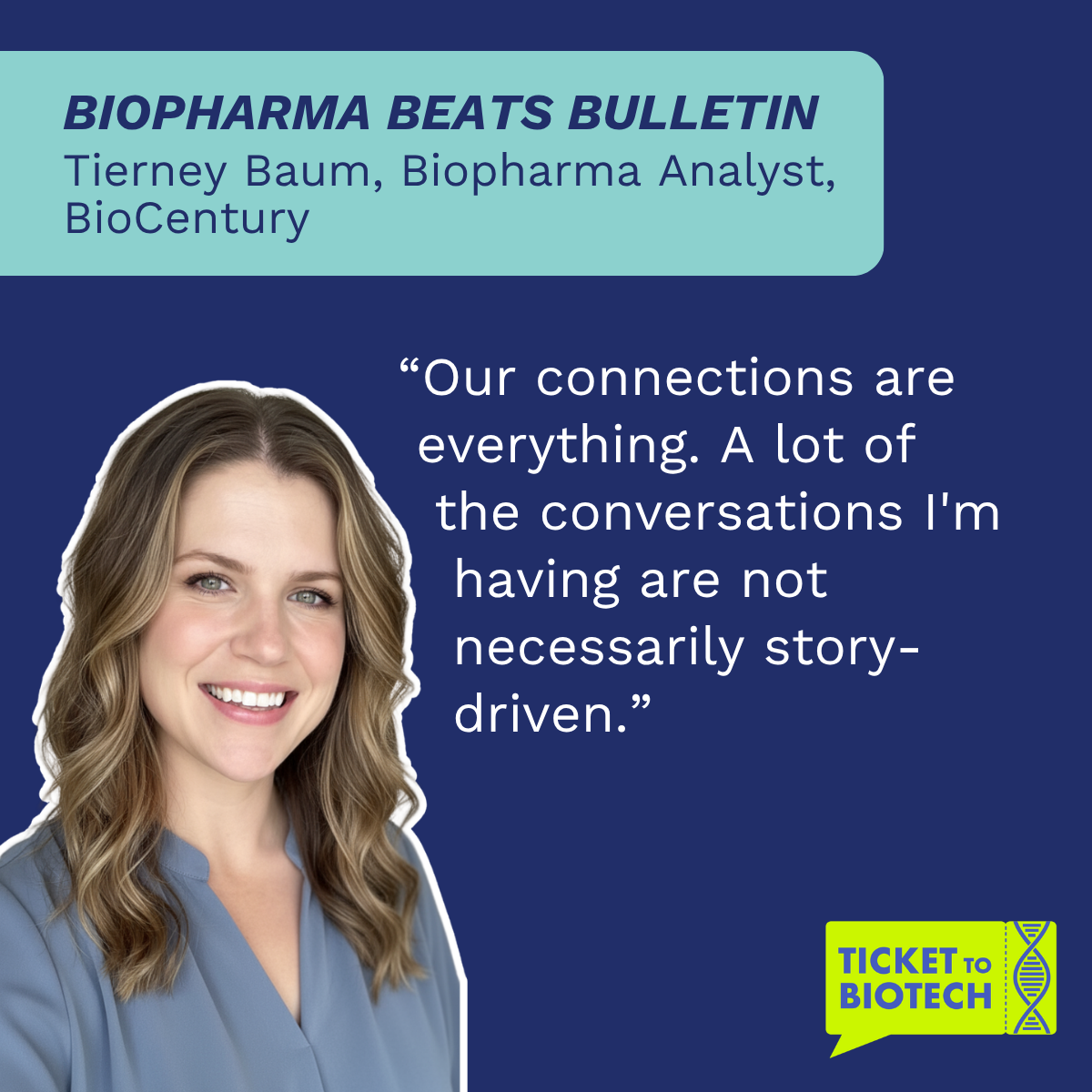
- Keep background calls on the table: Tierney values relationship-building as much as story-driven conversations. She holds multiple background calls every week, even when there’s no active story. If there isn’t a clear hook yet, a well-timed introductory conversation — especially in a clinical area she covers — can put you on her radar ahead of a future story. “Our connections are everything. A lot of the conversations I’m having are not necessarily story driven.”
- Trust her to ask the right questions: Once you’ve given her the fundamentals, Baum takes it from there. She doesn’t need a pitch to walk her through every angle — she needs the raw material to do her own research and shape the story. “Tell me what that is. Don’t make me go do the work to figure out why this is exciting… and then I’ll do my own research and figure out how to dig deeper.”
Pet Peeves
- Walls of text: Dense, unbroken pitches are one of Baum’s most consistent complaints. If the key information isn’t findable within seconds, the pitch loses. “Walls of text, very hard to read and get through.” Format matters as much as content — make it scannable.
- Promotional vague language: Phrases like “paradigm shifting,” “best-in-class,” or “unique differentiated platform” without specifics are red flags. Every company uses them, which means they communicate nothing. Baum’s threshold for engagement is hard evidence, not marketing language. “Everybody thinks they have the greatest drug, everyone’s paradigm shifting. If it comes off like it’s just promotional, you don’t know what the story is there.”
- The teaser pitch: Emails that promise a great conversation but withhold the actual substance. “Reach out if you’d like to learn what makes us unique” is a phrase that is particularly frustrating. Baum wants the substance upfront, not a prompt to request it.
Events and Conferences
- BioCentury Grand Rounds Conference (Seattle June 3-5): BioCentury’s translationally focused conference — distinct from their more business-oriented programming —is open to both companies and academic researchers. If you have scientists or translational leaders who’d be relevant attendees or potential connections, this is worth noting in outreach.
Key Quotes
“Help me help you.” (on what good pitching comes down to)
“Get to the point and tell me why I should care about this immediately. Put it within the therapeutic context — how is this company adding to the conversation in this disease?”
“Assume that the person is not going to go to the website. Give me all the basics about why this is differentiated. Bold, highlight, whatever you have to do.”
“Where’s the signal? We’re always looking for where’s the signal.”
Lightning Round
- Daily reads: New York Times, Wall Street Journal, and Washington Post. Plus BioCentury’s internal Slack, where the team collectively tracks regulatory and administration news that touches the biotech ecosystem daily
- Preferred AI tools: Perplexity is her current go-to; BioCentury is transitioning to Claude; she’s also experimenting with AI image tools (Nano Banana, BioRender’s AI) to enhance editorial visuals
- Pitch format: Email with clear, formatted structure — surface the differentiated claim immediately; don’t make it a scavenger hunt
- Best angle to catch her attention: A rare or under covered indication with recent momentum, especially in neurodevelopment or rare disease
- Outside the office: Hiking the Triangle trails with her cattle dog mix, Pilates, and newly learning to sew— the PhD problem-solver in her appreciates the challenge.