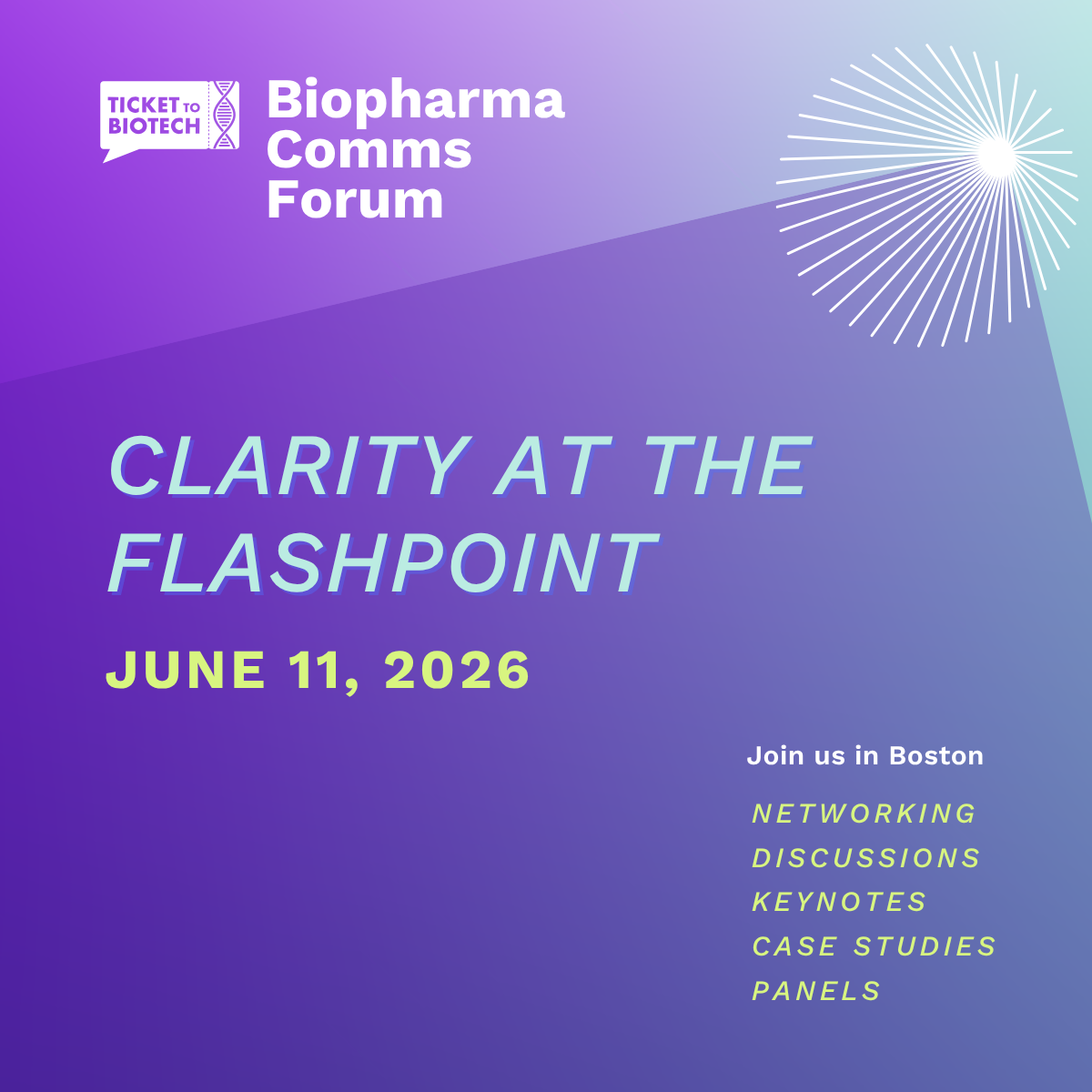
Second Annual Biopharma Comms Forum

Clarity at the Flashpoint

Date: June 11, 2026
Location: Northeastern Alumni Center
Program: 8 a.m.-5 p.m.
Reception: 5-7 p.m.

AGENDA | SPEAKERS | REGISTRATION

Clarity at the Flashpoint

We see patterns others miss because we’re connected across stakeholder ecosystems, identify risks before they crystallize by monitoring signals from patients, physicians, regulators, investors, and employees simultaneously, and act decisively when others freeze because we’ve built influence systems that survive budget cuts, leadership changes, and restructuring.

Clarity at the Flashpoint examines how senior communications leaders navigate true uncertainty, build sustainable influence, orchestrate complex stakeholder systems, and lead with authority.

Agenda overview

Opening Keynote Session — 9:10 a.m. ET

Headline Thinking

We’re all drowning in information, yet genuine connection has never been rarer. As communicators, we spend our careers teaching others how to move people, build trust, and create meaning. Yet when it comes to our own presence and relationships, especially with colleagues in our own industry, we often forget to apply the very principles we know work. This opening keynote explores what separates communicators who truly move people from those who simply check boxes. Through stories and candid observations about how we show up in conversations, Jessica Abo challenges us to think differently about what truly powerful communication looks like in practice.

Key Takeaways:

  • Analyze why the communicators who create real impact think differently about their audience
  • Create lasting impact through compelling stories that stick in people’s minds long after data and statistics fade away
  • Review how the principles of powerful communication apply to your own presence and influence
  • Build authentic professional relationships by sharing your story and experience, understanding that what you have to offer matters regardless of your career stage or role
Opening Keynote Speaker — 9:10 AM
Jessica Abo

Jessica Abo

Jett Communications

Founder and CEO

Panel Session — 9:45 a.m. ET

Trust, Influence, and the Staying Power to Lead

Establishing trust in life sciences is the operating foundation that determines whether everything else we do as communicators lands or falls flat. We are building credibility systems across external audiences and inside our own organizations simultaneously, managing the gap between how the industry sees itself and how patients, regulators, investors, and the public actually experience it. The conditions have never been more layered: misinformation moves faster than facts, AI-generated content blurs what is real, and internal influence can dissolve overnight when leadership changes or restructuring hits without warning. This panel opens a conversation about how senior corporate affairs leaders develop and protect the dual competency required right now of rebuilding credibility externally when science meets skepticism, and building influence internally that has staying power even when you’re not in the room.

Key Takeaways:

  • Examine how to establish genuine authority with boards and C-suite leaders, moving beyond access to actively shaping how trust-critical decisions get made before a crisis forces the conversation.
  • Map the trust gaps between your clients’/organization’s current positioning and how patients, regulators, and the public actually perceive it, and develop a proactive strategy rather than a reactive one.
  • Strengthen the internal political capital that keeps communications central when organizations restructure, champions leave, and budget conversations come for your function first.
  • Consider how the role of communicators is expanding from managing defined stakeholder groups to actively shaping broader public understanding of science and the industry, and what that means for how we lead.
Panel Moderator — 9:45 AM
Rowan Walrath

Rowan Walrath

Associate Editor and Life Sciences Reporter

Chemical & Engineering News

Panel Speaker — 9:45 AM
Karla MacDonald

Karla MacDonald

Chief Corporate Affairs Officer

Entrada Therapeutics

Panel Speaker — 9:45 AM
Marisol Mendez Peron

Marisol Mendez Peron

Senior Vice President, Communications & Corporate Affairs

Genmab

Panel Speaker — 9:45 AM
Laure Park

Laure Park

Founder

ParkEdge Consulting LLC

Presentation — 11:00 a.m. ET

What the First AI in Biopharma Communications Survey Reveals

Built for the realities of life sciences communications, T2B’s inaugural AI in Biopharma Communications survey examines how adoption is actually taking shape across workflows, teams, and roles, from early experimentation to deeper integration within our profession. Developed through the T2B AI Roundtable with  Knowledge Partner Syneos Health Communications, the survey also looks at where formal policy and day-to-day behavior diverge. The findings shed light on how expectations for the life science communicator’s role are shifting across in-house teams, agencies, and independent consultants. Forum attendees get the first public look at the findings, along with additional insights and bonus content available only in the room.

Download the full executive summary here.

Key Takeaways:

  • See the first public benchmark data on how AI adoption is actually showing up across biopharma communications roles and work environments, and where life sciences diverges from broader industry trends.
  • Understand how communicators are moving along the adoption spectrum, from early experimentation to workflow integration and more advanced use.
  • Discover where policy, governance, and approved tools align with reality, and where shadow use, access gaps, or inconsistent enforcement may be shaping behavior beneath the surface.
  • Explore what the data suggests about how the communicator’s role is evolving, including shifts in skills, influence, cross-functional collaboration, and expectations at different levels of seniority.
  • Walk away with specific data points you can use immediately in conversations with leadership about AI governance, training investment, resourcing, and the future of the function.
Presenter — 11:00 AM
Ryan Flinn

Ryan Flinn

Communications Consultant

In Like Flinn Communications

Presenter — 11:00 AM
Eve Siegel

Eve Siegel

Head of Research & Analytics

Syneos Health Communications

See our "AI in Biopharma Communications" survey results

Panel — 11:35 a.m. ET

What AI Makes More Valuable

AI may be able to accelerate more work than most organizations are currently using it for, but the gap between theoretical capability and real-world deployment remains wide. In Anthropic’s latest labor market research, actual usage trails far behind what large language models could theoretically do, especially in fields like ours where verification, accountability, and trust still matter deeply. For communicators, that gap is where the conversation gets interesting. The communications work that carries the most weight includes knowing when to push back on a CEO, building trust with stakeholders over years, and translating complexity in ways that require human context. This panel looks at how AI is redefining our work, which capabilities and skills are becoming more valuable as adoption spreads, and what that means for how we lead, advise, and position ourselves going forward.

Key Takeaways:

  • Identify which parts of the communications role are most likely to be compressed, accelerated, or delegated to AI, and which become more valuable when scrutiny, complexity, and stakes rise.
  • Strengthen the case for communications as a judgment-based function, especially when leadership is tempted to equate faster content production with stronger strategic counsel.
  • Guide your team through the shift from tactical output to strategic counsel, helping them reframe their contribution around interpretation, influence, trust, and decision support.
  • Sharpen your ability to read executive dynamics and advise leadership in moments where context, instinct, and relationship history are the deciding factors.
  • Consider what this means for junior talent development at a moment when some evidence suggests hiring may be softening in more AI-exposed roles.
Panel Speaker — 11:35 AM
Jaren Madden

Jaren Madden

Chief Corporate Affairs Officer & Head of Investor Relations

Schrödinger

Panel Moderator — 11:35 AM
Lindy Devereux

Lindy Devereux

Vice President, Communications

Flagship Pioneering

Panel Speaker — 11:35 AM
Nicole Fichera

Nicole Fichera

SVP

CannonDesign

Panel Speaker — 11:35 AM
Kerry Ryan, M.S.

Kerry Ryan, M.S.

Director, Global Executive Communications and Data, Digital & Technology Business Partner

Takeda

Case Study — 1:30 p.m. ET

Case Study: Behind the Headlines of Sarepta’s Communications Strategy

When safety events, shifting access, and relentless media attention converge at the same time, communicating with precision, consistency, and humanity under conditions that make all three harder than they look becomes the real measure of a communications team. In 2025 the Sarepta team found itself navigating exactly that kind of pressure, making real-time decisions about how to respond, what to protect, and how to stay connected to the people most affected while the news cycle did not slow down. This case study takes the room through that journey candidly, offering a rare inside look at how a team made decisions under sustained scrutiny and what it actually takes to protect organizational trust when everything is playing out in public.

Case Study Presenter — 1:30 PM
Tracy Sorrentino

Tracy Sorrentino

Vice President, Head of Corporate Affairs

Sarepta

Small Group Breakout Discussions — 2:15 p.m. ET

As part of the Forum’s commitment to candid, practical dialogue, attendees will join one small-group breakout session designed to foster real-world knowledge-sharing. Each group will explore a distinct facet of the modern biopharma communicator’s role. Attendees can choose the topic most relevant to their interests and join a 30-minute discussion led by a peer facilitator, with guided prompts to spark conversation and connection.

Communicating With – Not Around – Patients

Patient insight is one of the most credible inputs available to biopharma communicators, and one of the most consistently brought in too late. This discussion explores how we listen earlier, interpret patient signals responsibly, and translate lived experience into clearer decisions about trust, access, and reputation. The conversation will also address where the line sits between elevating the patient voice and relying on patient stories to carry the weight of the company’s story.

Facilitator: Noelle Piscitelli, Former Global Head, Oncology Communications at EMD Serono

Culture, Belonging, and Employee Trust Under Pressure

Culture becomes harder to sustain during restructuring, budget pressure, leadership change, and public debate over DEI. This discussion will focus on how communicators can help leaders speak with clarity, maintain employee trust, and reinforce belonging when internal audiences are watching closely for what is said, what is avoided, and what still holds.

Facilitator: Cheya Pope, Global Senior Vice President, Corporate Communications, Menarini Stemline

Making Sense of Policy and Public Affairs Signals

Government and public affairs issues are moving quickly, and communications teams are often expected to understand the implications before the internal picture is fully clear. This discussion will explore how communicators stay informed, connect policy developments to stakeholder strategy, and build practical systems for turning fragmented updates into useful guidance.

Facilitator: Ben Bradford, Head of External Affairs, MassBio

Investor Engagement in a Changing Market

The investor landscape has shifted, with institutional, private equity, and venture capital each bringing distinct expectations, and AI tools now parsing earnings calls and transcripts alongside analysts. This discussion focuses on how investor and analyst engagement is evolving, what traditional models still offer, and how communications and IR can work together to tell a credible long-term story.

Facilitator: Ian Karp, Head of Investor Relations, Collegium Pharmaceuticals

Growing the Next Generation of Biopharma Communicators

In a field that changes faster than most training programs can track, staying current is a challenge, and so is developing the next generation of communicators who are learning this craft in a very different environment. This discussion explores how we approach our own continuous growth, how we coach and develop our teams, and what the talent pipeline in biopharma communications needs.

Facilitator: Tanya Wymer, Executive Director of Enterprise Communications, Biogen

Breakout Session Facilitator — 2:15 PM
Noelle Piscitelli

Noelle Piscitelli

Former Global Head of Oncology Communications

EMD Serono

Breakout Session Facilitator — 2:15 PM
Cheya Pope

Cheya Pope

Global Senior Vice President, Corporate Communications

Menarini Stemline

Breakout Session Facilitator — 2:15 PM
Ben Bradford

Ben Bradford

Head of External Affairs

MassBio

Breakout Session Facilitator — 2:15 PM
Ian Karp

Ian Karp

Head of Investor Relations

Collegium Pharmaceuticals

Breakout Session Facilitator — 2:15 PM
Tanya Wymer

Tanya Wymer

Executive Director of Enterprise Communication

Biogen

Panel Session — 3:15 p.m. ET

High Expectations, Finite Capacity

Biopharma communicators are being asked to deliver more, with less, and the gap keeps widening. According to Meltwater’s State of PR 2026 report, 24% of PR and communications professionals cite insufficient resources as their top challenge, and 69% do not expect their budgets to increase in 2026. The pressure to optimize can quietly erode quality and capacity, and from the inside it can look a lot like extraction. Knowing the difference matters for our teams, our influence, and our ability to show up clearly when it counts. The cost of under-resourcing is often felt long before it is acknowledged. This panel takes a candid look at what strong communications leadership actually requires when capacity is limited and expectations stay high. We’ll talk about how to make smarter decisions about where communications should lead, where work can be shared or streamlined, and how to recognize when “efficiency” is masking real risk to teams, priorities, and business outcomes.

Key Takeaways:

  • Evaluate whether your current staffing mix, agency relationships, and tools are actually earning their keep, where AI and automation can take work off your plate without sacrificing quality or strategic oversight, and where the current model is simply helping the organization postpone harder resourcing decisions.
  • Distinguish between healthy efficiency and patterns of overextension that quietly erode quality, relationships, and strategic output.
  • Identify where cross-functional partners can genuinely share the communications load and how to structure those working relationships so collaboration reduces pressure without creating new coordination overhead.
  • Strengthen your ability to talk with leadership about capacity in business terms, including risk, decision quality, speed, stakeholder confidence, and team sustainability.
  • Recognize the early signs that a lean model is no longer strategic and what it takes to reset expectations before burnout or performance erosion sets in.
Panel Moderator — 3:15 PM
Kate O’Malley

Kate O’Malley

VP, Corporate Affairs

Moderna

Panel Speaker — 3:15 PM
David Murdoch

David Murdoch

Director of Corporate Communications, Social Media and Executive Visibility Lead

Sumitomo Pharma America, Inc.

Panel Speaker — 3:15 PM
Georgina Vincent

Georgina Vincent

Executive Director, Communications

Charles River Laboratories

Panel Speaker — 3:15 PM
Tracy Vineis

Tracy Vineis

Vice President, Communications

Apellis (now a part of Biogen)

Closing Keynote Session — 4:05 p.m. ET

Building the Architecture of Clarity

Clarity is rarely lost all at once. It erodes — decision by decision, compromise by compromise — inside systems that reward reaction over reflection and performance over presence. Drawing on behavioral science, organizational research, and the lessons learned building a cross-functional biopharma communications community through one of the industry’s most volatile stretches, this session examines what clarity is actually made of, why it breaks down under sustained pressure, and how to deliberately rebuild it. We’ll move through the neuroscience of stress-impaired judgment, the research on professional identity fracture, the data on how network isolation narrows cognition, and arrive at a practical architecture for stabilizing influence when the ground keeps shifting.

Key Takeaways:

  • Recognize the specific mechanisms that erode clarity under sustained organizational pressure
  • Anchor decisions to values that function as real-time filters, not aspirational statements
  • Cultivate curiosity as a discipline that expands perspective precisely when environments contract it
  • Build community that functions as cognitive infrastructure
  • Protect judgment from the structural forces most likely to compromise it
Closing Keynote Speaker — 4:05 PM
Lynnea Olivarez

Lynnea Olivarez

T2B Founder